In Constants, Jack explores the silent struggles of Liam, a teenager navigating school life while confronting his mother’s serious illness.
Through evocative imagery and poignant symbolism, the narrative contrasts everyday routines with private grief, revealing how ordinary moments become emotionally overwhelming when life changes, yet the world continues moving forward regardless.
The Assessment: As part of the QCAA English 2025 Syllabus, students crafted an imaginative narrative demonstrating purposeful language choices, characterisation and creative expression.
Congratulations, Jack, your thoughtful storytelling, sophisticated imagery and sensitive exploration of grief demonstrate impressive creativity and maturity.
A beautifully crafted piece that reminds us everyone carries a story beyond what we see.
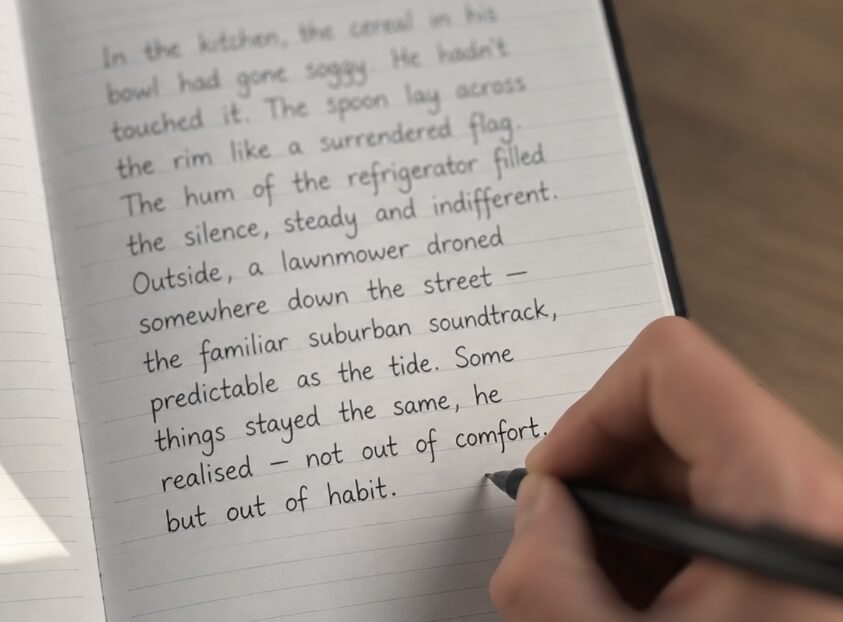
The morning light seeped through the blinds in thin, exhausted stripes, as if even the sun was too tired to enter the room fully. It pooled on the carpet beside the bed where his mother lay, her breath rising and falling in shallow, uncertain increments. The glass of water on her bedside table trembled with each exhale — a tiny, quivering moon caught in daylight. Liam watched it more than he watched her. The water was easier to understand.
The house held its breath with her. The walls, once a soft suburban yellow, now seemed to sag inward, as though they too had grown weary of pretending everything was fine. The air smelled faintly of antiseptic and the lavender lotion she used to wear when she still left the house. It clung to the room like a memory that refused to fade.
His father stood at the foot of the bed, shoulders bent in a way that made him look smaller than he was. The man’s hands — usually steady, capable things — fidgeted with the frayed edge of the bedsheet. A thread came loose. He didn’t notice. Liam did. He always noticed the small things now: the way his father’s jaw tightened when the doctor called, the way he blinked too slowly when he was tired, the way he lingered in doorways as if afraid to enter or leave.
“Morning, mate,” his father said, voice thin, stretched. Liam nodded. Words felt too heavy for mornings like this.
His mother stirred, eyelids fluttering like moth wings. “Hey, sweetheart,” she whispered, her voice a soft crack in the quiet. She reached out a hand — pale, birdlike — and he stepped forward so she wouldn’t have to reach far. Her fingers brushed his wrist, warm but fragile, as though her touch might dissolve if he moved too quickly.
“You’ve got school,” she murmured, though she said it like an apology.
He knew. The uniform hung on the back of his door, pressed the night before by his father, who had ironed the collar three times without realising. The shirt smelled faintly of starch and something else — something like effort stretched too thin.
In the kitchen, the cereal in his bowl had gone soggy. He hadn’t touched it. The spoon lay across the rim like a surrendered flag. The hum of the refrigerator filled the silence, steady and indifferent. Outside, a lawnmower droned somewhere down the street — the familiar suburban soundtrack, predictable as the tide. Some things stayed the same, he realised — not out of comfort, but out of habit. Not all constants were kind. His father placed a hand on his shoulder. The weight of it was gentle, but the tremor beneath it was not. “I’ll be here,” he said, though Liam wasn’t sure who he was trying to reassure.
Liam slipped on his shoes by the door. One lace was shorter than the other — his father’s rushed handiwork. He didn’t fix it. The unevenness felt honest.
When he stepped outside, the air hit him with a brightness that felt almost cruel. The street was the same as always — neat driveways, clipped hedges, the neighbour’s dog barking at nothing. A world unchanged. A world unaware.
The walk to school felt longer than usual, though the footpaths were the same cracked concrete they had always been. Each step sounded too loud in his ears, as if the world had turned up its volume just to spite him. A magpie warbled from a powerline, its song bright and effortless. How generous, he thought, for a bird to sing without knowing who could no longer hear it.
The school gates yawned open, metal bars warmed by the sun. Children poured through them in clusters — laughing, shoving, orbiting one another with the chaotic gravity of planets too young to know they could collide. Their voices rose in a tide of sound that washed over him before he could brace himself. It was a different kind of tide than the one at home — not slow and aching, but quick, sharp, insistent.
He stepped into the schoolyard, and the world erupted. A handball smacked against the asphalt. A whistle shrieked. Someone yelled his name.
He flinched before he turned.
“Liam! You’re late, man!” It was Josh, grinning with the kind of ease that came from a life unshadowed. His shirt was untucked, his shoelaces mismatched, his hair sticking up like he’d wrestled the wind and won. He tossed the ball in his hand with casual confidence. “C’mon, we need one more.”
Liam opened his mouth, but nothing came out. The words he needed — I can’t, not today, not ever — tangled somewhere between his chest and his throat. Josh didn’t wait for an answer. He grabbed Liam’s sleeve and pulled him toward the court.
The asphalt radiated heat. The painted lines were chipped, flaking like old memories. The ball thudded against the ground, rhythmic and relentless. Liam stepped into the square. The sun pressed down on him, bright and unbothered. How generous was the sun just to shine, and not to ask why his eyes were already stinging.
The game began. Hands slapped rubber. Feet skidded. Laughter ricocheted off brick walls.
Liam moved automatically, his body remembering what his mind had forgotten. The ball came to him. He hit it. It left him. The world spun on.
But the laughter — that was the hardest part. It rose around him like static, too loud, too sharp, too alive. It grated against the quiet he had left behind at home, the quiet that clung to him like a second skin. He felt it tearing now, thread by thread, as the noise pressed in.
A shout went up — someone had won the rally. Josh whooped. The others cheered. Liam forced a smile that felt like it belonged to someone else.
The bell rang, slicing through the air. Children scattered toward classrooms, a flock startled into motion.
Liam lingered.

Growing Up Well with Wait Mate
At King's Christian College, we recognise the growing challenges families face as children navigate an increasingly digital world. That is why we support initiatives like Wait Mate, which encourage…
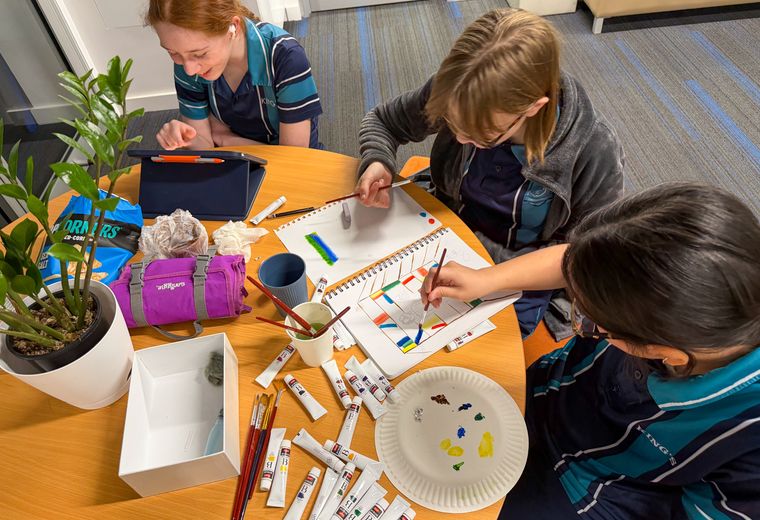
Write a Book in a Day – 12 Hours, 5 Books and an Incredible Achievement!
Creativity, collaboration and determination were on full display as 33 King's Christian College students from Years 7–11 took on the exciting Write a Book in a Day challenge, raising an outstanding…